She Wears a Wire that Runs All the Way to Stockholm
Published Thursday, April 27, 2006 by Jeff.
 The Essex Green -
 The Essex Green -
Prior to actually sitting down to pound out a blog from this worn keyboard, I generally obsess mentally over what I'm going to say, how I'm going to approach a piece of music or a band. Rarely I discover that I really needed to write about something else entirely. Sometimes the finished piece is better than what I imagined. Often over the course of research I find that some of my points are completely unoriginal.
I was going to talk all about how Essex Green manages to walk that fine line between nostaglia and admiration, how they manage to exist in timeless space—creating songs as indebted to the pop of the past as entrenched in contemporary mires, and how Brooklyn hipsters and scuzzy garage-rockers could both find common ground on the Essex Green, but the Merge Records blurb sums it all up much more efficiently: "timeless pop that is classic without being retro."
Another interesting point is that Cannibal Sea, The Essex Green's latest album was actually recorded in both Brooklyn and Ohio. So maybe there is something to my somewhat pejorative reduction of geographies and genres. Moving beyond bi-coastal, Essex Green manages to be both Red and Blue, and neither.
In full disclosure, Cannibal Sea is the first Essex Green record I ever bought. But that infernal Radio Io Edge... Everytime "This Isn't Farmlife" came on I thought to myself, what a great song, stopped working, and clicked on iTunes to see who it was. And "Cardinal Points" seemed to capture a lot of what I love about Caribou and my Nuggets box set. And hopefully someone is burning me some of their earlier stuff too... So there may be more Essex Green in Cacophony's future.
The Essex Green is making their way out to LA on Sunday, May 7 at Spaceland. And have about 10 shows after that as they make there way back to New York on May 18.
(Buy Cannibal Sea from Merge.)
The Fourth Best Band in Kingston Upon Hull
Published Tuesday, April 25, 2006 by Jeff.
 The Housemartins -
 The Housemartins -
If the jangley pop topped with layers of harmony isn't enough to get you interested in The Housemartins, maybe these keywords from their Wikipedia page will:
Marxist politics; born-again Christianity; attacking his business partner with an axe; the future Fatboy Slim
The Housemartins spanned from 1983 to 1986, going through a few members in the process. (And yet, I'm just now discovering them.) The band's image changed throughout the years from an exciting live band with quirky songs to a more serious, Marxists-in-cardigans look but the lyrical content seems to stay consistantly focused. Curiously enough, none of the "Christian" tinged work made it onto the "Best of" album, but the Marxist influence is easy to find. What keeps this material from sounding trite or dated is great songwriting and musicianship. For me at least, it wouldn't matter much what they were singing about, the unabashedly poppy and soul-inspired songs could do it. And regardless of the lyrics' meaning, the style and phrasing is brilliant at times. There's a "coy, self-deprecation" that spreads across their work that keeps the Das Kapital references in check, too.
The best description comes perhaps as a metaphor from an anonymous messageboard: The Housemartins are the UK's Credence Clearwater Revival.
1) Associated with unpopular forms of 'root' rock. Like CCR played rootsy American tunes in an age of psychedlics, Housemartins played their 'skiffle' influenced tunes in an age of hair metal.
2) Their clothing was plain and simple. CCR: flannels. Housemartins: Cardigans
3) While their clothing perhaps made them out to seem conservative, their views were exactly the opposite. Take CCR's "Fortunate Son" and Housemartins "Sheep."
4) Both bands come from the backwoods: Northern California and Northern England. And both bands took swipes at the city folk.
5) People who might otherwise be embarrassed about liking American roots or Skiffle will admit to liking CCR or The Housemartins.
Curiously enough, their final bass player, Norman Cook, later changed his name to Fatboy Slim and made some good music videos.
And apparently the car dealer/partner-gone-bad had it coming when Hugh Whittaker attacked him with an axe.
(Buy The Best of The Housemartins at Amazon.)
Father Loose Fur, You Never Looked So Sane (Sorry.)
Published Friday, April 21, 2006 by Jeff.
 Loose Fur -
 Loose Fur -
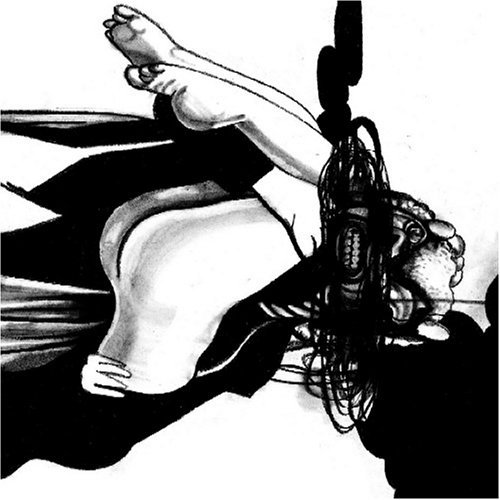
I've got your sunshine weekend right here at 128 kbps.
Sitting in front of a computer for over eight hours a day might not be your favorite way to spend a day, especially when that computer is at the office. And although I have to listen quietly, the internet radio helps make my days go by much easier. At first I tuned into Indie 103.1 just to drown out the KOST that was infiltrating my ears from across the office, but as I discovered more and more strictly online stations I became a discerning listener searching out the best mix I could find.
Enter Radio Io's Edge program. "Playing the best of twenty-years of college rock and alternative... as well as today's best indie acts," Edge manages to play the perfect mix of songs I know and love as well as new stuff that I really dig. I listened for about a week to the free 128 kpbs stream via iTunes before I got totally sick of the same commercials over and over and fell totally in love with the mix of tunes. Five dollars a month seemed like a reasonable amount for 160 hours a month of good music, so I subscribed.
And it was worth it. Not only do I get the music at a CD quality stream, I get this great pop up window that refreshes each time a new song comes on. The window displays the last ten songs played as well as icon links to find out more about each song played. One click and I can buy the album online or read all about the artist. (So then I jot down the album title and label and look it up later.)
On one occasion my coworker (and drummer) asked what I was listening to. When I said Radio Io Edge, she replied, "Oh, does Sean dj that?" And yes, he does. Apparently Sean Ziebarth is a bit of a local boy who used to (still does?) dj at KUCI. He had found a copy of a Former Friend CD (our drummer and keyboardist's other band) a few months back and contacted them for his own copy.
Dude. I love this guy even more.
So thanks to Sean, this 'free' radio stream has given me a list of new CDs to buy and will most likely end up costing me a whole lot more than if I had just settled for "Steady as She Goes" nine times a day. (Though thanks to allofmp3.com I was able to get a few of those records checked off all for under $10.)
And this Loose Fur album, Born Again in the USA, did not disappoint. It moves between the glamorous discordant pop of Aladdin Sane-era Bowie, restrained, open-ended post-punk and as "The Ruling Class" shows, heavy does of The Velvet Underground.
The more you know, the more you realize how much you don't know. And I'm not too proud or elitist to admit that I know virtually nothing about Wilco. Maybe if I did, I would have been clued in to this Loose Fur side-project. Maybe having a knowledge of the Wilco catalog gives a better (or worse?) context for understanding Born Again in the USA, but if so, I wouldn't know it. Someone (anyone?) out there who's into Wilco, let me know what you think. (You can leave a comment by clicking the number next to the blog's title.)
Have a whistling weekend.
(Buy Loose Fur Born Again in the USA at Amazon.)
(Check out Radio Io, and their Edge program, here.)
I've Got A Clan of Gingerbread Men
Published Wednesday, April 19, 2006 by Jeff.
 The Vindictives -
 Pink Floyd -
(Too many covers? Too soon for more Vindictives?)
Did you ever like a band because you were supposed to? When I was first getting into music, my entry way was 'classic rock' mostly via KLSX and their annual Labor Day Top 100 Countdown. One year I taped the top 25 or so and tried desperately to take note of who sang which song. There were a few tracks by Pink Floyd, who up until that point were purely a band I had seen t-shirts for. They seemed good enough and seemed to mentioned in the same breath as The Doors, Zepplin or The Who. So eventually I decided I needed to own at least Dark Side of the Moon. I listened to it a bit (since it was probably among the 6 CDs I owned) but could never totally get into it and let my interest in Pink Floyd fade away.
The story could end there. Or I could have been completely turned off to the band after I discovered just who really listened to Pink Floyd and wore those t-shirts. But whenever "Comfortably Numb" or "Money" came on the radio throughout the years, I'd at least listen for a little while before changing the station.
Harsh Segue.
The Vindictives released a double-10" of all cover songs in the mid-nineties, Partytime for Assholes, which was intended to be a tribute to the various bands but comes closer to a Dickies tribute. One of my first music-geek projects was to compile all of the original songs. This was before the days of the internet and I spent a lot of time listening to friends and digging through bargain 45 bins. I compiled most of the songs but there were a few that always alluded me.
On a random spur, I decided to get out my old CD copy of Partytime where all of the songs are combined into one long track. With my new computer skills, I realized I could finally break up that CD into a listenable version. Then I realized, why don't I just google some of these lyrics for which I never discovered the original artist.
One of the strangest songs covered is "Bike." I always wondered who could sing a song about mouse who hasn't got a house. (I don't why I call him Gerald.) The lyrics seemed almost a perfect for the Vindictives who once sang, "Everything I've got has certain places to go: a self for that thing and a drawer for that thing." And the stripped down punk version leaves a lot to the imagination as to the original music.
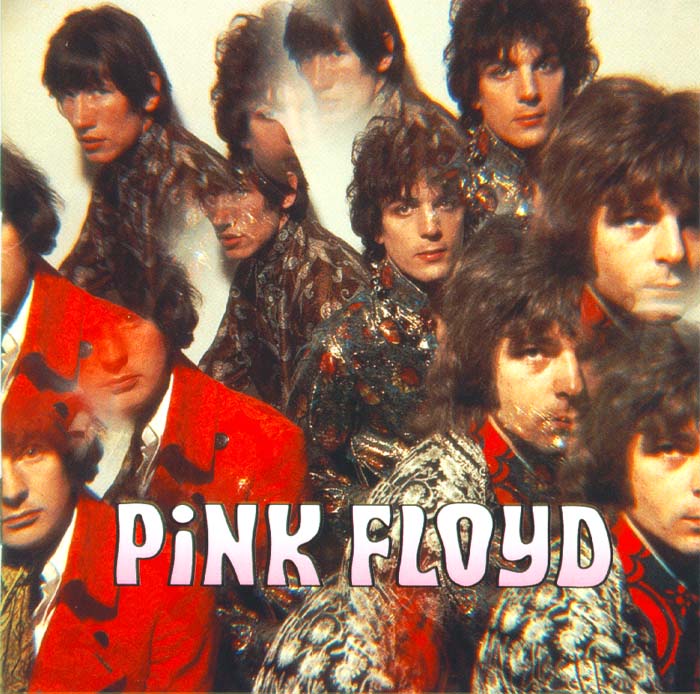
Google wasn't exactly straight with me. But I did find a post on someone's MySpace page with the complete lyrics attributed to S. Barrett. A little cross referencing and sure enough, "Bike" is a Pink Floyd tune. Closing out Pink Floyd's debut album, Piper at the Gates of Dawn, the deceptively simplistic structure and lyrics at the opening of the track mark a harsh contrast to the open orchestrated-noise given a minute-and-a-half in the song's finale. And keep in mind this was released within months of Sgt. Pepper's... There must have been something in the water; I think it was LSD.
(Buy Piper at the Gates of Dawn at Amazon.)
(Buy Partytime for Assholes at Amazon.)
The Gas is Leaking Since 1996 You Motherfuckers!
Published Monday, April 17, 2006 by Jeff.
 Milemarker -
 Milemarker -
The best and worst thing about working at a copy shop is that everyone asks you for favors. It worked out well a few times as I hooked up various local bands with demo or seven-inch covers or the locals art co-op with some new signage and flyers. And then sometimes friends of friends would want the hook up and things got more complicated. It's one thing to put my job on the line for something I support; it's something else entirely if someone who I don't even hang out with wants free stuff.
So a friend of a friend had some photos of a band and wanted to make them into posters. There were about 5 different pics and if I made an 18"x24" digital print of each I'd be ripping off Paul Orfella for around $180. I wasn't prepared to do that for someone I had barely even met once. (Though she did convince me to buy Le Tigre's first record the one and only time I met her at Noise Noise Noise.)
So I decided to make the posters on the blueprint copier (called an Óce by those in the biz). I scanned in the photos, half-toned them and everything, just to get the best possible results from the line-art reproducer. And while I'm scanning in the photos I think, wow, these guys look really cool (read: these guys dress like me and have similar haircuts.) When my friend came to pick up the posters (and was disappointed they weren't in color), I made to ask who this band was. Milemarker.
Coincidences generally occur in three and are rarely a happenstance. Soon after I was reading whatever the hip magazine of the day was, either Punk Planet or Skyskraper and came across a review of Milemarker's Anesthetic. The review only fueled my interest in this new band and informed me that Al Burian, who regularly writes columns for Punk Planet, was a founding member of Milemarker. Oh, I had to get this record.
But apparently it wasn't as important as getting the new Zeke record because I took my 'lunch' break at OCC to drive up to Vinyl Solution on Zeke mission. But after a B-line to the Z-section, my mission was a failure. And like all music junkies I decided to just look around and pick up something else to get my fix.
A CD packaged in all pink with a pegasus gracing it's cover caught my eye in the M's. Worth purchasing on the appeal of the cover art alone, it was the new Milemarker album I had read about.
And I didn't really like it.
Maybe six months later I decided to give the Milemarker disc another try. I can distinctly remember pulling into the Home Depot parking lot to buy art project materials and not wanting to stop the CD. This time something was different; I was ready for this. I'm not sure why "Shrink to Fit" (Anesthetic's opening track) didn't catch me right away on first listen, maybe I didn't it up loud enough. But on this occasion all the elements were in place and when "A Quick Trip to the Clinic" blared out of my stereo speakers as I pulled into that Home Depot I knew I was hooked.
I've kept up with Milemarker throughout their releases and collected some of the albums which came out before Anesthetic. (Including Frigid Forms Sell You Warmth, which is one of the greatest album titles of all time, and contains what I'd call my 'favorite' Milemarker song, "Sex Jam Two: Insect Incest," and its close runner-up, "Cryogenic Sleep.")
"Landlord" makes it way to your ear from Milemarker's fifth and latest album, Ominosity. Released back in October of 2005, I was only recently able to pick up a copy of this disk. Normally I can't stand psuedo-journalistic text in band's promotional schpeals, but this time all the hype hits the mark. Ominosity really does sounds like the album Milemarker has been trying to make all along... and I loved the earlier work. This is some twisted news for new listeners because if you don't like this album you most likely won't like the other ones, and if you go out and buy this album first it's may seem all down hill from there. But, I'm going to post "Cryogenic Sleep" just for some sort of context and perhaps even if you fall in love with Ominosity you can still find the gems on the other records.
You can download two other tracks from Ominosity here.
(Buy Ominosity at Insound.)
(Buy Frigid Forms Sell You Warmth at Insound.)
Beatles Covers Week Part Four: I Wanna Hold Your Standard or And I Cover
Published Thursday, April 13, 2006 by Jeff.
 Sufjan Stevens -
 The Skatalites -
Paul Weller -
Do you know that song "Chicken Reel" or "Turkey in the Straw?" Your first answer might be 'no,' but if I hummed a few bars you'd most likely reply, 'Oh, that's what that song is called.' Through Looney Toons and commercial jingles, you've most likely been exposed to these songs; they have entered the collective unconscious.
And while I'm deathly afraid of the folks who think "Surf City" is a Beach Boys song, I have a feeling they are growing in number. As music becomes "ubiquitous as water" in our culture, it stands a chance of becoming just as bland and rote. If you were forced to listen to your local Oldies station daily, you'd probably get completely sick of their 20-song playlist. You might not care to remember that Them sang "Gloria," like you might not have bothered to find out that Caplinger's Cumberland Mountain Entertainers do a killer version of the Chicken Reel. Or that name of the song played in every cartoon when an assembly line is featured is "Powerhouse" by Raymond Scott.
But there is something potent and relevant in approaching a song that everyone knows, that hold a place in the collective unconscious. The main reason you have tunes that are considered 'standards' in a genre like Jazz, is the heavy reliance on improvisation within that genre. There was a time when most people knew the melody to "Misty" or "Take the A Train," so when they heard an avant garde arrangement they could recognize where it was being altered, improved or broken down. A standard could also be an opportunity for showmanship and impressaro performance. When the listener has a context for the tune, the musician can play with the listener's expectations.
Maybe that's why I'm a sucker for tracks like Ted Leo covering Kelly Clarkson or Arcade Fire playing Yeah Yeah Yeahs. Maybe these are today's 'standards' and maybe their life-span is growing increasingly shorter. (Or backwards as with Iron and Wine and Postal Service.)
These three tracks all start with a Beatles song and treat like a standard. There is no rock-god reverence, just using a song in the pop music vernacular to launch their own creativity. The beauty in these tracks in how much they reinvent these songs, like a good cover should.
When I listen to Rubber Soul, I usually skip "What Goes On." I've never really been able to get into the Ringo songs, but Sufjan's version completely flips the script. And I don't usually go for much pre-Rubber Soul material but this ska version of "I Should Have Known Better" (dubbed "Independent Anniversary Ska") by The Skatalites makes perfect sense to me. And Paul Weller brings it all together with his blue-eyed soul rendition of "Sexy Sadie." And while Mr. Weller doesn't push the original nearly as far as Stevens or the Skatalites, maybe there's just enough of a difference in arrangement to hear what he's going for... taking a shot at recreating one of the most beautiful songs ever written. You can hear his respect for the original maybe just a little more than you can hear his desire to remain fresh. So as a "standard cover" goes, I think Sufjan just left The Jam man in the dust. (But it should be noted that I believe Weller is honoring the song, not deifying it, nor trying to pass it off as his own a la Quiet Riot covering "C'mon Feel the Noise.")
But if you never paid attention to the Beatles, then maybe these are just some more pop songs floating about in the ether. If you never thought it was important to remember just who sang "I Wanna Hold Your Hand," then you probably aren't even reading this, but I think we all know people like this. Maybe it's someone at your job, at school, or maybe even a relative, but surely we all know people who just don't care. I think I just feel sorry for all they miss out on. And I shudder when I imagine a future where listeners relate to "Love Me Do" like we relate to "Turkey in the Straw."
"Ignorance of your culture is not considered cool."
(Buy This Bird Has Flown at Amazon.)
(Buy The Skatalites at Amazon.)
(Buy Paul Weller at Amazon.)
Beatles Covers Week Part Two: When I'm (Commodore) 64
Published Tuesday, April 11, 2006 by Jeff.

I had a few SID tunes that were Beatles covers and researched them to death... Only to stumble upon Merman/Ozone's demo site. See, the beauty of an old system like Commodore 64 is the "ease" with which one can create their own games or music, often called 'demos.' I used to create little text-based games for my Commodore by copying in the Basic code from my monthly 3-2-1 Contact Magazine. But in the hands of a true musician/composer, the SID chip can astound you. Merman takes on the daunting task of recomposing some of the Beatles later work on his The Beatles Anthology v.II. I'm sorry to give you so many songs, but it was hard enough narrowing it down to these four.
One of my favorite things about chip music, SID tunes in particular, is the limitations of the technology. Like The Beatles were able to produce Sgt. Pepper... with 'simply' a four-track, SID composers face the challenge of composing using only three-voices. Breaking a song down into elemental units, down to the necessties, often allows the listener the ability to realize how truly intricate these compositions are.
Generally, Merman attempts to remain true to the original tunes note-for-note; it's the medium that's important. But his sped-up rendering of "Happiness is a Warm Gun," is my latest jam. I love it when those drums kick in. Of course, that's probably my gun-to-my-head favorite Beatles song... so it doesn't hurt to start with something I already love. (Though that could be dangerous too, as in his rendition of "Flying.")
And imagine trying to recreate the studio magic of "I Am the Walrus," yet somehow his SID version captures the spirit of the original in a completely new context.
Merman (Andrew Fisher) also has some Spice Girls and Blur demos and some Mr. Men and Pokemon slideshows for your C64 emulator. If you'd like to check them out...(Click Here.)
I've also posted "When I'm C64," by my entree into the remix/home-electronica forum, I Feel So Pixelated. I'm pretty sure the lyrics were inspired by Jan Lund Thomsen's podcast, The C64 Take-Away, but I could have totally dreamt that up too. I had a 30-second sample of "When I'm 64" and wanted to add something to it... so I added a drum track, bass line and some vocals. It may possibly be the geekiest thing I've ever done. (Even topping the Patrik Remix by A.M.)
(Download The C64 Take-Away Podcast)
(Download more from Merman. {Emulator Req.})
Plotting Probing my Rear Opening
Published Friday, April 07, 2006 by Jeff.
 The Vindictives -
 The Vindictives -
I haven't had a 'real,' full-time job since January 2002. I worked at Kinko's for over four years prior to that, from when I was 18 to 22. Perhaps numerically that's not a whole lot of time but anyone who's made it past twenty-five can attest to how hard those years really are. Some pop psychologists have coined the term, "Quarter Life Crisis," because the same general symptoms seem to be widespread. At some point after leaving high school, or college, most people have to confront the fact that they will now be working at a job for their rest of their lives. Reality kicks in and it leaves an ever-growing bruise.
For those of you who met me recently, it may be hard to envision me in this period. I don't think Patrick believed me when I first told him about how I'd spike the free coffee with Drain-o, but I was so full of rage and depression then. Let's face it, the prospect of basically wasting away your life at a stupid job is horrendously depressing and dealing with the public daily is enough to instill rage in Tibetan monks.
But the quarter-life crisis was not something that we actually talked about in Psych 100 so I thought I was just losing my mind. It seemed like everyone was completely capable and complicit with this daily grind. I thought maybe I had some kind of Persecution Complex or Oppositional Authority Disorder. I was forced to read a Dr. Dobson book to Prepare for Adolescence, but nobody told me that 'real life' was so absolutely shitty. The Vindictives helped me out immensely. Singing along to Joey's lyrics as I collected my two-dollars in change for the toll road from OCC to my Kinko's was really what kept me going. Belting out "you can't control me" over a wall of backing vocals, doubling Joey on "don't let them make you think you're weird" or "you look at me and shake your head and say that I'm not sane / While watching sitcom reruns is the highpoint of your day," seemed the closest thing to reassurance I could find. Punk is filled with disaffected voices but something in The Vindictives lyrics and sound resonated with me. I'd heard all about why I should hate my job and the cops and that I should burn the church, the cross and the money that makes us hate, but I never heard a lyric and said, 'that song's written for me,' until I heard 'Assembly Line.'
Like I said earlier, I was working at Kinko's, so I photocopied the lyrics and thumbtacked them to my bedroom wall. I tacked them up right by my closet so every morning as I cinched up my tie or packed my book bag I could remember that it was okay not to be one of them. I could remind myself that their 'vulgar anecdotes won't lure me into an assembly-line life.' And there's something more than the sum of the words there, an unspoken hopefulness to the self-deprecating anthem. Of course there's the not-so-subtle mocking of the square culture too, but the closing line became my mantra: It's my intention to defend my volition.
"...and the world isn't flat anymore," had to be posted in this context as well. First of all, just take the title (and repeated ad nauseum outro), the phrase is packed with meaning. Considering the second and third lines of the song, "And if I change my mind about things / I know that I will change it again" this song touched on something I'd been thinking about a lot lately. As we laugh at Columbus' neigh-sayers with our contemporary knowledge that world is indeed round, what are we wrong about today? What will the future being laughing at us about? "...and the world" closes out The Many Moods of the Vindictives and seems to offer Joey's summation of everything addressed previously. Yeah, this life is pretty shitty and it will most likely make you crazy and it's full of emptiness... but we do have a chance at a better future. It's a far cry from a political song but as I became more jaded against my own political ideals, the idea of long-term evolution rather than a drastic revolution seemed more and more realistic. And it empowered me. I couldn't start Marx's dictatorship of the proletariat but I could live my life in a way that didn't embrace our culture's answers to our current problems. I could live a good life and hope that it would catch on, inspire mutation. Maybe if I treated everyone I encounter in life like a human being then my customers might not treat me like shit... and the world isn't flat anymore. You're a living time bomb.
('Assembly Line' Lyrics)
('...and the world isn't flat anymore' Lyrics)
(Buy The Vindictives The Many Moods of the Vindictives at Amazon.)
These Are the Days that I Will Remember
Published Wednesday, April 05, 2006 by Jeff.

Sicko played their final show in Seattle, Summer of 1998. It was the same Summer my grandfather passed away. And while that might seem like a harsh segue, I opted to stay in Southern California for funeral services rather than join my friends on their pilgrimage north to see Sicko's last show. Of course, I heard all about it and Dave even wrote a song for our band ESL immortalizing the experience. (I even got to do my best Ean impression/tribute on the backing vocals.)
But my memories of Washington are much more complex and almost bipolar... and of course they too involve Sicko. When ESL 'toured' up the West Coast we had a nice long stay in Olympia that culminated with a show not far in Bellevue. Our tour was totally D.I.Y. which meant we were booked at an all-ages Boys and Girls club. But it also meant that we were responsible for setting it up in advance. As a shot in the dark, Dave suggested we ask Ean's new band, Tales from the Birdbath, to play with us. After informing us that Birdbath didn't quite have the same following as Sicko (read: no one will come), Ean agreed to play the show.
Similarly to Sicko getting to record their debut seven-inch with Kurt Block, playing with Ean, even if it wasn't with Sicko, was like a dream come true. And even though nobody came except for two kids and the guy whose house we were staying at in Olympia, I can still remember knowing that I was playing for Ean. That dude from Sicko was listening to my band. I was so far from home yet I felt so at ease and so 'successful.' It's hard to sum it all up.
But as we were packing up our gear something happened. The best I can piece together is that Matt, our drummer for the tour, called Dave's mom a 'fat, Catholic bitch,' and the next thing I knew Matt was chasing Dave down the streets of Bellevue pleading, "Just talk to me." And Dave was insistent that he'd just kick Matt's ass if he didn't just give him some space. End result: Matt was at the SeaTac Airport in a matter of hours and our at-home drummer was on the Greyhound bound for Vegas, our next stop.
I can't remember being as elated and fulfilled as I was playing for/with Ean. I can't remember ever being as angry and full of rage as when I saw the whole thing seem to fall apart.
Of course Dave wrote a song about that night too. There's some geographical inconsistency but I think Dave says "Seattle" just because Bellevue was too obscure. I'm pretty sure that I came up with the title for the song because I honestly believed that Bellevue Mental Hospital was in the town we played. (I can still remember when Dr. Kinsman informed me that Bellevue was actually in New York...but whatever, that makes it a more clever play on words.)
So I've posted 'Bellevue Mental Hospital' so you can get Dave's take on the whole situation with a bit of salt. While it's not my favorite song that we ever recorded, I'm glad that there is a documentation of the event beyond my own memory. (And I still like my Buggles-esque backing vocals.)
I've also posted 'Come Home' from ESL's seven-inch, M.I.O.K., because I think it shows best how much ESL was indebted to Sicko. I'm not sure if any of my songs sound anything like Sicko, but Dave certainly had an affinity for those jangle-y guitars and big hooks. It's not a pure tribute; there's a heavy serving of Orange County punk in the mix and it's a lot faster. But I still think you can hear it. This actually is one of my favorite ESL songs and curiously enough Dave wrote it about someone he and I both ended up dating. (And having our hearts broken by... Dr. Kinsman's daughter actually.)
 You lucky readers also get the opportunity to download 'Olympia' by Tales from the Birdbath. You can definitely hear the end result of the Sicko trajectory in Birdbath. It's a stripped-down pop song with a winking sense of humor. My favorite lines are "It's a nice place to visit but I wouldn't want to stay / O-L-Y-M-P-A / That's Olympa. Olympa!" Birdbath played 'Olympia' that night and it was just perfect. Our host even apologized afterwards for booing when the song was introduced. "I live there though," Ben said. Ean replied calmly from under his sweat-drenched t-shirt labeled "" on front and "" on the back, "No, that's exactly what someone from Olympia is supposed to do." Even if you've never been to Olympia you can get a kick out a sugary-sweet pop song glorifying the K and Kill Rock Stars uber-hipsters up north. (Though I did actually see Sun Moon's little brother working at the local record store.) And if you did go to Evergreen (or ever dreamed of it) then you can get a knowing laugh about going "to a college where you don't get grades."
And to sum it all up, to bring this three-day thread to a close, is Ean's beautifully written 'Indie Rock Daydream' from Sicko's final album, You're not the Boss of Me. As if knowing the end was imminent, Ean pens a touching rendering of the experiences of playing with Sicko, encapsulating their entire career in under two minutes. It's the details that make it: playing at the YMCA, pretty girls leaving with someone else, and sleeping on the floors of the world. It's not the same story as Motley Crue or even Black Flag but it's the story of countless bands in the D.I.Y. culture. And soon enough, this will all be gone.
(Buy Sicko You're Not the Boss of Me from Amazon.)
(Buy Tales from the Birdbath Baron Von Birdbath from Amazon.)
(Buy ESL Horseshoes and Handgrenades from me, bitches)
There're Seeds of Hope in a Cigarette Butt
Published Monday, April 03, 2006 by Jeff.
 Sicko -
 Sicko -
Sicko -
In the Spring of 1992, Sicko recorded their demo cassette in a basement somewhere in Washington. Of the songs which made their way to be rerecorded for the debut seven-inch was a little ditty called "fB Song." Named after the infamous Washington icons, Fastbacks, Sicko's tune about not 'necessarily hat(ing) the establishment," must have touched a nerve in Fastback's guitar hero, Kurt Bloch. For some reason or another, Bloch was persuaded to record the session for Sicko's debut seven-inch on eMpTy Records.
 Imagine doing your first 'real' recording as a band with one of your heros. Imagine getting to record your tribute song with the man who helped inspire it. I suppose it would be a lot like George Martin producing Oasis' demo tape or Prince laying down tracks with Justin Timberlake before he ever stole our hearts with 'N Sync.
Growing up I always thought Sicko was among the pantheon of 90s pop-punk bands like Screeching Weasel, The Queers and The Mr. T Experience. Nowadays I rarely find anyone who recognizes even these bands, let alone Sicko. (My heart skipped a beat when a barely-18-years-old lanky drummer said he was really into Crimpshrine a few months back.) In my mind and among my circle of friends, Sicko was just as important as Dead Kennedys and The Dead Milkmen: full iconic, canonized status.
I've posted three tracks that Sicko recorded with Kurt Bloch over the years. "Sprinkler," from You Can Feel the Love in This Room, 1994, Sicko's first album, features Denny on the vocals keeping it real for the kids who grew up in suburbia. A nostaglic ode to times gone by could be totally cheesy but somehow manages to stay "cute" and remain "poignant." This is one of a group of Sicko songs that really immortalize Denny as a songwriter for me. (And as a sidenote, the clean-guitar/distorted-guitar in this song essentially set the template for the pop punk I played in.)
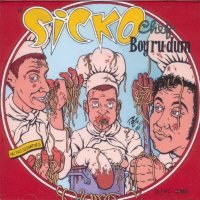
"Bad Situation" is probably the fastest that Ean ever sings on any of the Sicko records, this track coming from their third album, Chef Boy 'R' U Dumb, 1995. Ean and Denny switched-off with lead vocal duties and even between bass and guitar, but there's some general differences to their song writing approach. Ean is generally more narrative and fanciful and playful, where Denny is generally more introspective and poetic. The beauty of the band was having both parts together, alternating between tracks.
"80 Dollars" features a brilliant use of the dual-vocal setup where Denny sings the verses about Ean, who gets to bring the hook, "It cost me eighty-dollars!" This track was recorded in 1992 (released as a split seven-inch with The Mr. T Experience) and remains to be the best song about a guitar tuner ever written and features the most rhythmically complex solo bridge in the pop punk annuls.
(Buy You Can Feel the Love in This Room from Amazon.)
(Buy Chef Boy 'R' U Dumb from Amazon.)
CACOPHONY AND COFFEE
- OR POP HISTORY
- OF NONEVENTFUL YEARS:
- AN MP3 WEBLOG
Latest posts
- Wake Up it's Time for Work
- Surf Will Tear Us Apart (Again)
- How Much Art Can You Take? (Or There's Something A...
- It Takes Time To Get It Together
- I Keep the One I Love in the Freezer
- My Baby Does the Water Damage
- 1998 Looked Great On Plain White Paper
- How to Fix Oldies Radio
- I Feel This Burning Pain
- Take a Bow
Archives
Links
- 20 Jazz Funk Greats
- Appears.2ya.com
- Banana Nutrament
- Benn Loxo Du Taccu
- Between Thought and Expression
- Bows + Arrows
- Brooklyn Vegan
- Caffeine Headache
- Captain's Crate
- Cocaine Blunts & Hip Hop Tapes
- Cokemachineglow
- Copy, Right?
- Dalston Oxfam Shop
- Diddy Wah
- Domino Rally
- Elbo.ws
- Empires Fall
- Fluxblog
- Gorilla vs. Bear
- Hype Machine
- Indie For Dummies
- Miss Jaime
- Moistworks
- Music For Robots
- Popsheep
- PopText
- Said The Gramophone
- Sit Down Stand Up
- Souled On Music
- Soul Shower
- Soul Sides
- Stereogum
- The Number One Songs In Heaven
- The Rich Girls Are Weeping
- The Tofu Hut
- Underground Cinema
- Underneathica
- Vain, Selfish and Lazy
- We Eat So Many Shrimp
- You Ain't No Picasso
Disclaimers
- Songs posted here are only available for a limited time and are for evaluation purposes only. If you like the music, please show your support and buy the records.
- Feel free to contact Jeff or Patrick if you are a band, label or distributor and think we'd be interested in your music.
- If you are the copyright holder of a song being featured on this blog and want us to take it down, let us know, and it will be removed from the server immediately.
Site Feed