Wake Up it's Time for Work
Published Tuesday, September 26, 2006 by Jeff.
 Cursive - Dorothy Dreams of Tornados
Cursive - Rise Up! Rise Up!
Date> 25 September 2006
To> patrickkilpatrick@gmail.com
Subject> Wake Up it's Time for Work
Hey there, Patrick...
I was thinking about a few things on the way home from work today; one of them being the power that words have to clue us in to new music. In particular I'm reminded of My Morning Jacket who had never interested either of us until "Z" came out. Even though they had other records out (and we've listened to some since) there was never anything in any of their reviews that prompted either of us to check them out. But "Z" was something different. Out of the My Morning Jacket CDs, it sounds the most like one we'd be into. So thank goodness somebody reviewed that record with enough sense to fill in the appropriate Jeff-and-Patrick buzzwords.
I was also thinking about how sometimes even a "bad" review will use strange terms and phrases that will pique our interests as well. The quickest example I can think of is the "Castlevania guitar tones" on the latest Mars Volta record. Even if the reviewer is using the term negatively, it evokes something positive for us.
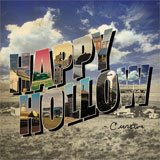
So here I am, on day 7 of a nearly incessant Cursive binge and I want to write the review for the latest album, "Happy Hollow," that makes you want to check it out... that lends a pair of fresh ears and new pair of specs. (One's that don't earn the ire of your supervisors, perhaps?) Because beyond if you even end up liking the record, let alone the band, I think this record explores a lot of ideas that you and I have talked about before (and even written songs about.) And maybe it's just me, but I love it when someone 'established' has similar ideas as I do... especially if those ideas are relevant and important. And beyond the lyrical and meta-meanings of the record, I think it sounds absolutely brilliant. (More on that later.)
I try pretty hard not to be a typical art-rocker or a closed-minded rockist, as you know. So concept albums are almost always hit-or-miss for me. I have no love affair for "Tommy" or "In Search of the Lost Chord," but if a good album comes along labeled as "concept," I'll admit it. (Note: my closet love affair with Coheed and Cambra.)
But Cursive's "Happy Hollow" is a concept record unlike all others. There's some more typical demarkations like the bookending musical themes on the record and repeated lyrics and melodies throughout the songs, but most of it feels like a good dramatic play or movie. Rather than forcing Cursive songs into some conceptual mold in order to make them fit on the record, the band finds fertile and plentiful material in their own self-imposed set-up.
I'm not sure if it's because I was forced to read and watch it so many times, but for some reason I hate "Our Town." So it pains me to compare "Happy Hollow" to it, but it's the best I can do... maybe "Our Town" crossed with some French New Wave director who focuses on a few characters in depth rather that telling the story of one archetypal hero... (Can you think of a good example?) But like a genius director, the stories of all these characters combine to form a meaning, a message, a story, bigger than the individual pieces themselves.
The cover art is the first clue. Referencing old postcards, the art depicts an anywhere-town that is desolate, boring and completely run-of-the-mill. At first I wasn't sure I'd be able to get into this record as much as "The Ugly Organ" because I can relate to playing in a band, but I wasn't sure about relating to small town life.
But "Happy Hollow" is more about the delusions and games that people play in this small town in order to keep going on. (And I've found them relatable to the point of obsession.) I suppose I can relate especially to the struggle of growing up with certain religious truths presented as solutions and never having the chance to objectively see them as diversions.
In a lot of ways, this record is about the "culture war" between the Red and Blue states... between the University and the Church, Science and Religion. It's about "Normal Life" and the meaning of existence. There are tales of alienated priests so human and well-rendered... beyond charicature of simple black-and-white. All the characters in Happy Hollow are complex and dimensional. There are tales of girls who's boyfriends are off at war, grown men doubting their faith, and head on confrontation with "intelligent design." (And the Wizard of Oz flourishes actually work rather well...) And while there isn't a real story arc, listening to the album in its entirety feels complete... like you're ready for a cigarette, a sigh, and muttering, "Well, that was a good flick."
You know, maybe it's not a concept album after all. Maybe it's just a good album. Maybe albums are supposed to be more than a collection of singles... maybe they should be more like a "body of work"... but "Happy Hollow" feels more like a city-sized mural than a portfolio or gallery show. The ambition and scope are breath-taking.
And what really brings it all together is the music itself. While I was bummed at first that there would be no cello on this record, (Cello! You have a bass!) I soon found myself at home in the almost free-jazz horn arrangements. Cursive has this thing where they load up the beats with like 10 guitars, a bass and snare hit, and now, bizarre horn arrangements. If for nothing else, check out "Happy Hollow" just for the way the songs sound. There really isn't anyone else out there doing this... and if there's anything close I want to know all about it. And the songs on this record have this off-kilter gospel vibe that I can't quite place. The only thing that comes close is Lord Have Mercy On Us. It's loud and powerful and full of angst, but it feels like gospel. It's like the flip-side of gospel... post-apocalyptic gospel as I like to say.
But there's also some slide guitar that brings out the real Americana elements to the music. And of course that only adds to further the concept of small town life. But then of course there's the lyrical content atop those familiar tones... and the songs never sound like period pieces or revivalism... they feel painfully like now. (And now I think I might be repeating myself...)
So I know there are segments of our musical-taste Venn diagrams that don't cross, but I'd like to move Cursive out of that section and into the intersection... at least "Happy Hollow." I wouldn't go to all this trouble for nothing; I think you'd be missing out if you didn't at least give it a listen... maybe look up some lyrics online...
"Rocking chairs of disenchantment, green grass of envy and malice - our salad days, living in Happy Hollow."
Jeff
Surf Will Tear Us Apart (Again)
Published Monday, August 21, 2006 by Jeff.
 Mister Loveless - Family Jewels
Mister Loveless - A Prison Break
First off - Hi, How are you? It's been a while. These blogs can be so strangely surreal and completely awesome at the same time. Getting email from some of my musical heros and other artists I've covered is one of the coolest perks I could have asked for. And beyond that, sometimes you get to hear from voices thought long in the past. When I made a passing remark about my first kiss, the other guilty partner in our middle school rite of passage actually found the post and wrote me a little email... and even posted a comment on the blog. (Which I'm about to hyperlink in one sentence.)
Back in May, I mentioned briefly my first musical phase involving the Beach Boys. I'm still a little unclear why I sought out Surf music or even more specifically the Beach Boys but surfing was definitely cool and I'm thinking one of my friends must have had a Beach Boys tape. And in thinking long and hard about the subject, I'm pretty sure I convinced Aaron to let me stay the night at his house just so I could listen to his tape some more. (And I think he said he had one more tape at home too... and maybe I could listen to that as well!)
Like most kids, he had a greatest hits compilation album. But some time later, I convinced my mom to let me buy a tape from the local Alpha-Beta. Tell a friend. (If that means nothing to you, it's because Ralph's later bought Alpha Beta and I never saw thier Richard Simmons-like spokesman again.)
I remember my dad taking exception to the little note on the cassette's cover: Due to time constraints, some songs from the original album may not be contained on this cassette. I remember he said, "I wonder what songs you don't get to hear." Or something to that effect. But I was a kid and didn't really have any clue about what an 'album' really was, in fact, I don't think I was really clear on the concept of what a band was either. In the fourth grade, at the peak of my Beach Boys infatuation I got to see them play live. You would think I would have been totally excited and amazed to get to see my idols live, but I remember being sort of bored. (Especially when Chicago was playing first.) I remember being more excited about seeing an Oldies cover band at the Pear Fair in Walnut Grove. I mostly recall being totally pissed that we had to walk around the fair and couldn't just stay and watch the band. I really remember that...I was super pissed. I don't think there's any way a 10 year old can rationally express that kind of resentment.
So a few weeks ago, I went ahead and bought the Beach Boy's first three albums. I think I have a fairly solid grasp on 'albums' and 'bands' now and I'd like to re-listen to these songs without having to resort to old, well-loved cassettes.
I may sound like a total moron here, but I had no idea the Beach Boys actually played surf-rock. I guess I always just thought they came up with their folk-inspired and surf-inspired music naturally in Southern California. But apparently the aging county fair mainstays started out recording versions of "Miserlou" and "Let's Go Tripping." I think maybe all the instrumentals got cut from the cassette versions. Somehow my whole vision of the band's early days has shifted. I started to wonder if the real surfers listened to instrumental stuff like Dick Dale and thought adding vocals was a mainstream, sell-out move.
Don't get me wrong, I think the Beach Boys vocal arrangements are true genius and no doubt molded my impressions beyond repair. (It's an easy segue from Beach Boys to The Queers, Screeching Weasel and all that pop-punk I love and have loved... and even to Essex Green or Mates of State.) But I was amazed how much the music had affected me as well. I didn't know in the fourth grade who played guitar or bass, or even who the lead vocals were on which song, but somehow the music still got through. After hearing "Surfin' Safari" and "Help Me Rhonda" thousands of times since, I actually listened to them. I'm still a sucker for that classic surf beat on "Surfin Safari" and that catchy little riff on "Help Me Rhonda."
So where does that leave me? Do I start attending touristy beach festivals and rocking out with a Hawaiian shirt and khaki shorts? Thankfully, there's some folks out there who might just love surf music as much as I do but approach from a contemporary, underground-y perspective. Indebted as much to Fugazi and Joy Division as much as anything Southern California produced in the 60s, Mister Loveless, create a an amalgamation of sounds that just sounds ridiculous on paper. At first I was wary of a band claiming to be the missing link between surf-rock and post-punk. I didn't think there was such a link... nor really any need for one. But then I heard the music.
The X meets Y formula is such a shallow short-form, but it's hard to explain a band in terms everyone will understand and quick enough so you don't lose their attention. So maybe it's a perfect explanation for potential fans (and bloggers), but the music is much richer and sincere than a quick tagline description.
While more and more bands attempt to pull off some sort of Ian Curtis delivery with less and less sincerity and more and more empty style, Mister Loveless manage to capture what has endured Curtis for generations: the palpable desperation. That's a fellow human being delivering those vocals. I can relate to that isolation. And I'm not sure if I'm a good enough writer to explain how even the guitar tone and melodies manage to espouse some sentiment of alienation and anxiety. It doesn't sound like those dark, minor chords ala Nick Cave; the melodies are almost poppy. But there's a dark corner to even the most pleasing major scale, and Mister Loveless finds it, and dwells in it. And when they are working with a minor chord, dude, it gets dark and tense.
I may be doing the band a disservice making them seem so completely bleak. Don't forget the lingering elements of surf-rock I told you about earlier. The beats never leave you bored and shift from that classic 2-4 surf rhythm to a 16th note hi-hat disco attack to straight-ahead four-on-the-floor... and they never get showy, and never merely 'serve the song.' The unexpected beats elevate the band's sound into a new territory. Atop these drums strides languorous, desperate and oddly comforting guitar lines. And where so much surf gets mired in technicallity and reverb, Loveless remains human and accessible.
Beyond mimicking their favorite bands, or sounding like a band out of their time, or retro, Mister Loveless combines all the wrong elements in just the right way. The burn of isolation smells like today; the fumes are all too familiar. There is no second-degree emotion here, no sillouette of the dead past. Unfortunately this angst is all too 'of today.' Nowadays we can be isolated despite being connected to millions. It doesn't ache any less no matter how many friends I can add to MySpace. Looming on the horizon the big city beckons to a nation of centerless suburbanites. And how do we handle the day-to-day when a perfect tomorrow is only a freeway or interstate away?
That feels different than anything anyone could have felt ten, twenty, thirty years ago. We don't need anymore emotional rehashes of days gone by.
Mister Loveless Web Site
Mister Loveless MySpace
How Much Art Can You Take? (Or There's Something About That Blue)
Published Tuesday, July 11, 2006 by Jeff.
 The Thermals - No Culture Icons
Cursive - Art is Hard
Art Brut - Modern Art
As I'm sure you've realized by now, I place a tremendous importance on music in my life. I gain strength through solidarity, learn lessons vicariously and internalize and empathize with the similar ideas and emotions. My first google after being released from a two week stay in the hospital and discovering I had diabetes was "diabetic punk." There had to be some sort of anthem out there from a garage band sans working pancreas. I mean, Keith Morris, what are you doing nowadays anyhow? But I never found one and had to write it myself. ["(Who Put) The Beat (In Diabetes)"]
So when I hear a new song that is about or references something I'm into, my ears prick up and sometimes I fall in love. And while I've never heard a song about Graphic Design, I get excited when I hear Maximo Park reference A4 paper because I'm a big design nerd and know that's the equivalent of Letter size, or 8 1/2 x 11, in the UK. Perhaps I'm easy to please or am totally willing to admit that I enjoy a self-serve ego stroke time and again.
But when a band manages to write a great song about something I'm thoroughly passionate about, like Art, I usually have to change pants. Luckily, I have Cacophony and Coffee as an outlet or I would have to make sneak appearances to my art school alum and hand out mixtapes with accompanying essays. There could probably be scores of more posts from me in the future about art school bands, or even just RISD bands, but I'm not talking about artists making music or music as art, or anything like that. I'm talking about songs discussing art in the same way there are countless songs about love or being in love or being loved or the one that you love. Sure there are some classics like "Pablo Picasso" by The Modern Lovers, or maybe "Good Sculptures" by The Rezillos, but those don't really address the subject like I had in mind.
I discovered The Thermals "No Culture Icons" via Yahoo! Messenger when a friend of mine back in NYC (whose blog was recently condemned by AP official policy) recommended, neigh implored, that I go out and at least get the No Culture Icons EP. Well, since she's responsible for me and my Black Eyes (on a few levels?) I had to take her recommendation seriously and even shelled out the four or five bucks and the hours of download time to get the EP from iTunes that night. And I wasn't disappointed; I was even more impressed than she probably anticipated.
Not only does "No Culture Icons" possess a priceless 4-track-D.I.Y. warmth and charisma, it has some of the sharpest, layered and clever lyrics of all of The Thermals material. Subtle changes in phrasing create new meanings and often phrases mean two things at once. It's like taking all your art professor's rhetoric, all the post-modern academic buzz, and distilling into a perfect melody. But The Thermals don't just regurgitate their critique-speak professors; they offer commentary on the whole experience and question the whole notion. What is art besides "more stained paper"? And half of the song is dedicated to Thou Shalt Nots; it's hard to know where the sarcasm ends and where the artist's voice begins. The message is far from stable and open to the viewer just like good art. Maybe I've become too entrenched with academic art to realize how much of this song needs explanation to those outside our little niche, but I'm pretty sure you can at least recognize the word play if not grasp the full level of art references. And who knows, maybe I'm totally reading it wrong, but it's a catchy little number full of lo-fi charm even for you MBAs out there.
Cursive's "Art is Hard" doesn't neatly fit into my narrow category I specified earlier. It's pretty close to being the thesis of Cursive's The Ugly Organ, a self-referencing album about a tragic 'emo' singer. But the idea of sacrificing one's own happiness and hurting those near and dear in the wake for the sake of some "art" or "success," is a fascinating and important theme. The mythical iconoclastic artist with his black t-shirt and jeans, maybe even a beret, knows that HE must suffer for his art in some stoic pity party. And even in this age of "pluralism" the artist myth continues to thrive. How many times have you heard that you must suffer for your art? It's a cliché now, right? And yet, these tragic figures manage to find success in not only the mainstream-emo scene or TRL but also in the hallowed halls of the white cube: the art gallery.
Can you detect a note of personal bitterness? Maybe that's why I'm able to stretch Cursive's tale of a singer who sabotages his own life for some notion of success. Sure, I fall under the lure of the masculine-art-hero and think, 'oh I can't do that, normal people do that,' or 'nobody understands what's like to be an artist,’ But I have to wonder what I'm missing out on... and remember to be grateful for what I'm getting instead. I love how Cursive calls bullshit on the whole game. And I can sing it to my self in bitter protest and strange reassurance about all those 'successful' artists who just keep playing the same song over and over.
And in my opinion, Cursive (and The Thermals really) deserve their own post to really elaborate on their instrumentation and strange use of sounds. I first heard Cursive when a friend and I were exchanging mass numbers of CDs. He brought over his laptop to rip my collection and I rifled through his 100+ booklet with complete glee. What's Cursive like, I asked. Of course I got the obligatory, "You haven't heard Cursive?!", but then he said, "It's sort of like hardcore... but the have a cello." I grabbed the CD instantly.
Maybe strings are the go-to for musicians to feel more established or complex, but Cursive doesn’t arrange their songs in any typical fashion. The cello isn't simply tacked on; it's an integral part of the composition. And in the case of "Art is Hard" the strings are used as a pretty dissonant texture creating some serious tension. (Critique-speak: "Push-and-Pull;" "Melody/Dissonance" "Order/Entropy")
And finally, "Modern Art" from Art Brut. I encountered Art Brut somewhere in the blogosphere a few semesters back. I can remember distinctly because we were coincidentally covering the Art Brut movement in my Contemporary Art History class that week. This early modernist movement advocated the use of children's drawings, art by the mentally ill, and 'amateur' art as inspiration and insisted that every person was able to create art. What a great reference point for a band name. Of course most people just think it's a clever juxtaposition of disparate terms, like a soft explosion or hard water. But if you wikipedia 'Art Brut' you'll get a whole new level to the band's name. (Okay, Art Brut doesn't have it's own proper page, but read up on Outsider Art, Dubuffet or even Breton if you're interested.)
And this quote from the Art Brut Movement's founder, Dubuffet, might just change your mind about the band. They could be a lot smarter than you thought:
"Those works created from solitude and from pure and authentic creative impulses - where the worries of competition, acclaim and social promotion do not interfere - are, because of these very facts, more precious than the productions of professions. After a certain familiarity with these flourishings of an exalted feverishness, lived so fully and so intensely by their authors, we cannot avoid the feeling that in relation to these works, cultural art in its entirety appears to be the game of a futile society, a fallacious parade." - Jean Dubuffet.
Art Brut is a strange band and I'm not even sure if I really 'enjoy' them so much as they interest me. Their songs are hard to pull out of context because the album sort of sums up the band as a manifesto. Again, we have tons of self-reference... but taken to a new extreme. Art Brut is aware of being a band, an entertainment product, a potential cash cow for a music conglomerate, like Modern Art is aware of being paint on a surface. Without the need to recreate reality through paint and canvas, Modern Art is allowed to explore a huge range of subject matter, including itself. The Abstract Expressionists, like Jackson Pollock, were championed by the art scene and media, and most notably Clement Greenberg who managed to dictate the flat, pure color and 'contentless' work done by AbExers and Neo-AbExers. The reason we have to add the "Modern" instead of just calling it "Art," is mainly due to this distinction of art being 'allowed' to be paint-on-a-canvas, to reject tradition.
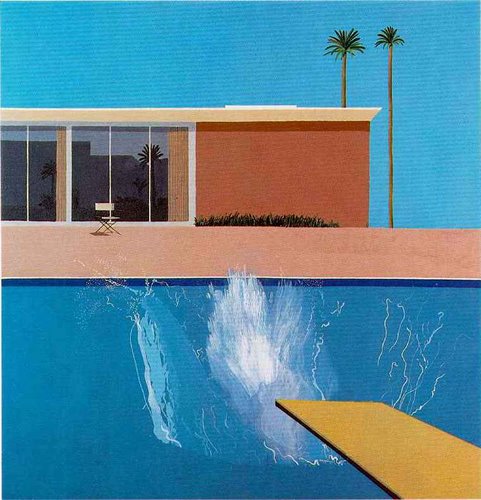
Is Art Brut that important? Probably not, but the way they carry the all-too-self-aware bit clear through the entire album, from lyrics to delivery to instrumentation, is quite impressive, if not revolutionary. And perhaps their song "Modern Art" is the only one in music history to sing about getting SO excited about Hockney of any art in general, but it has got to be the only one about reacting so viscerally that one dashes themselves into a Matisse. Modern art makes me rock out, too.
(Buy The Thermals No Culture Icons EP at Amazon.)
(Buy Cursive The Ugly Organ at Amazon.)
(Buy Art Brut Bang Bang Rock and Roll at Amazon.)
It Takes Time To Get It Together
Published Monday, June 26, 2006 by Jeff.
The Figurines - The Wonder (Video)
Hey Everybody. Be sure to swing over to Pitchfork Media today and check out their interview with The Figurines. Remember you heard them at Cacophony and Coffee first!
Don't you wish your band could be state-sponsored as Cultural Ambassadors!
And enjoy this great video that mixes parts Un Chein Andalou and Michel Gondry. Classic!
Pitchfork Interview: The Figurines
I Keep the One I Love in the Freezer
Published Thursday, June 22, 2006 by Jeff.
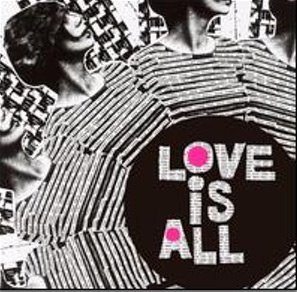 Love Is All -
 Love Is All -
I'm not sure why we do it, but whenever a band comes from someplace other than our hometown, we feel the need to draw comparisons with that locale's major exports. Perhaps it's a holdover from Elementary School reports about some country and we'd just grab whatever we could from the Encyclopedia. (I wonder if that's different now that we have the internet?) Maybe after writing so many reviews and blogs about music, we latch onto anything that sets this band apart. I could see that being the case for mainstream magazines, and blogs where the music covered never strays too far from one genre, but I don't think we should be able to get away with that here at Cacophony and Coffee. If Patrick had made some link between Chicago's famous architecture and Dwayne Wade... or even worse, some far-fetched comparison with Mrs. O'Leary's cow, I would have called him on that shit. (Not in a public forum... but he'd know.)
Lots of great stuff comes out of Sweden like Volvos and Muppet Chefs and Gummi Fish candy and my family-name. Lots of reviewers mention these things whenever they're discussing a band from Sweden. If they're lucky, the band warrants an Abba comparison, and then the writer can call it a day.
But I have a genuine comparison. Love Is All is Ikea in reverse.
Ikea provides affordable (read: cheap) furniture for those of us who have a little taste and just a little money as well. Ikea looks pretty nice and well-designed, but that's all on the surface. Closer inspection (and the fact that you put it all together with hex-bolts and Allen wrenches) reveals that this not investible, classic furnishing; it's a cheaper simulation.
Love Is All give it to us backwards. The recording is lo-fi and full of warmth and good old overdrive distortion. But the "cheap" veneer does not immediately reveal the intricate layers or musical complexity LIA is putting down. Their debut full-length could have been recorded with all the sound perfectly mastered and balanced in the vein of Yngwie or countless Praise bands, but I'm sure I wouldn't be as into it. The lo-fi quality is far from a pandering-to-the-crowd maneuver akin to Smashing Pumpkins "indie debut" either. It's the proper production for these songs. (And I'm already curious to hear how further records will be produced as well as how LIA might sound live with "professional engineering.")
Love Is All profess a strong affinity for Eno-era Roxy Music and the comparison is apt. Beautifully written pop songs are given an airy, experimental, almost atmospheric treatment that remains tight, nearly claustrophobic at times. The brilliant melody remains intact but the typical pop song clichés are avoided by throwing in a dash of distortion and 'skronky' saxophones. (And, of course, the production itself.) Every chance to take a wrong turn is missed; every decision seems to be the right one. Love Is All has all the right stuff to be a perfect band: punk veracity, pop hooks and melodies, an avant-garde edge, and an exotic foreign origin.
Of course, if you read Pitchfork daily, you've probably been after this record since their glowing review when the record wasn't even available in the States. But those of you who aren't obsessed with being hip or don't have some time to kill at work on a computer to keep up with the latest, take a listen to Love Is All. It's definitely been one of my most-played in the weeks since we've on hiatus. Maybe it'll be one of yours too.
(Buy Love Is All Nine Times the Same Song at Amazon.)
My Baby Does the Water Damage
Published Monday, June 05, 2006 by Jeff.
 Rah Bras -
 Rah Bras -
Rah Bras -
Rah Bras -
One of the things I used to do in between bands at shows was try to count up all the shows I'd been to. I can still remember the show when I realized I could no longer count them up. I had started going to shows pretty regularly and I just lost track somewhere along the way. I remember the band playing was called fLUF and they were just about the worst thing I had ever heard. Maybe they aren't so bad, but I certainly never gave them a second chance. I stepped outside to the patio at Old World and started to mentally go over the shows I'd been too. (I think it was partly because some of the first shows I ever went to were at Old World and it put me in a contemplative mood.) I felt slightly proud of myself for getting out so much and by the time I was done reminiscing it was time to try and grab a spot close to the stage for the next band, Jawbreaker.
It's hard to narrow it down to a favorite show ever, but that came pretty close. Despite fLUF's awful contribution, I can remember the other opening was called Blacktop Special or something like that (not Blacktop Cadence) and they had a rootsy sound and garage bin lids for cymbals. Goddamn... Blacktop something or other. At any rate, flash forward a few years and I'm discussing memorable shows with a co-worker and he brings up his first show ever: Jawbreaker at Old World. I reply with the standard, no, really? But deep down inside I want to say, "Aha, bitch! That was the show when I couldn't count up how many shows I'd been to... condescending asshole." But I don't say a word about it.... instead I soak in my own self-gratification like one-man reach-around. And like Colbert said, "That's a difficult thing to do, but worth it." (About the one-man reach-around, mind you.)
But what even trumps Jawbreaker for me was the time I saw Rah Bras at Che Cafe. Che's at least an hour and half away from where I live, but sometimes, when the bands were important enough, my friends and I (or sometimes just me) would head down to the UCSD campus for some 'intimate live music.' Back then the Che was really chill and there weren't any Security or professional booking agents; volunteers ran it all and they did a phenomenal job. I never had or saw any trouble at the Che.
When the Rah Bras played at Che, The Locust opened (or headlined) so some of my 'other' friends were there too. See, Locust is hard enough to balance out the 'weird' for these folks. They were more interested in Zeke's favorite Taco Bell items than what time signature or vintage synth The Locust were using. So when these squares were actually impressed with the Rah Bras, I knew they had something special. (Rah Bras, that is.) I think my friends were most impressed with the band's closing number, a cover of Ginuine's "My Pony." Whether or not my friends knew it was a cover is unclear, but they did enjoy the ridiculous lyrics and the way the drummer acted out the song.
Most impressive for me was the fact that the Rah Bras could completely pull off their insanely arranged songs. The layered and strange sounds all made their way to the stage that night. It was like having their songs spelled out for you and you're still in utter disbelief. They made all that sound with their mouths, a bass, keyboard and drums? And even more phenomenal, the drummer recreates his off-kilter beats with the technical precision of a fine craftsman. He totally rocked "Poisson" live like you couldn't believe. To this day I have no idea what he was playing on "Water Damage," but he managed to reach down to the floor, pick up this washboard-type-thing, and give it one hit, put it back down, and never miss a beat. Now if you've been reading for a while, or know me, technical proficiency is not really all that important to me, but when you witness something this incredible being created in front of you, and when you are familiar enough with the work to recognize the complexity, well, you just can't forget something like that.
Rah Bras have been, since Concentrate to Listen to Rondo We Christen King Speed came out so many years ago, one of my favorite bands. And their newest album is almost good enough to make me drop the "one of." I've never been able to commit to a favorite band, but Rah Bras just may be it. (Now admitting this opens me up to a lot... what if you HATE this band? Can we still be friends?) Perhaps it's because Rah Bras manages to embody just about everything I love about art and music. Yes, they have the skills but they also have a ton of ideas. Yes, they have a sound but they manage to progress with each release. And while I don't like Ruy Blas as much as the earlier EPs, this makes me like the band even more. Who else would attempt to create some kind of Medieval Sex Jam record? There's all the art but none of the artifice (unless it's sort of silly.) The keyboardist/vocalist sold used bras after the show rather than merch. And she even gave consultations on the best size. I think I would have called it 'performance' if I knew what that was at the time.
After a good friend and I attempted to discern the lyrics from the bridge on "The Fifth Allen," we sent what we had figured out to the Rah Bras. They even wrote me back with the 'correct' lyrics, but said that they liked our version better, I doubt that I could explain any better than this series of sound bites and anecdotes, but their latest record which came out late 2005, Whohm, surpasses all the esteem I already held for this band.
Their early efforts always had an epic, operatic underscore to them that sometimes worked well with their bizarre post-rock arrangements and sometimes took to the forefront. Whohm finds the same grandiose sound and vision but with such a refined focus it thumps you in the chest. And I could be mistaken, but I believe this album introduces to the Rah Bras with the Blast Beat, which is more potent than that most brutal cacophony of all time from "Bus Stop." Yes the double bass pedal can be used effectively.... or shit; maybe this guy just hits one that fast. I honestly wouldn't be surprised. Rah Bras also make use of the almost as hard as the whammy bar to use well, the synth pitch bender. Have you heard a better riff in your life than "Skin=Chronized?" How about one with bended notes? Ever?
The rest of the album is just as mind-blowing. (Did I really just use mind-blowing?) The rest of the album continues along the trajectory set by "Skin=Chronized," the second track, and builds from there. Each song contains so many details that are easy to miss for the big hooks and grooves. The sound is even fuller as Rah Bras uses the production to near its full effect in capturing and creating a gale force of timbre, textures and textbook music terms. I don't know what time they're playing in most of the time, but I know I'd be hard pressed to ever write a song so difficult. Once in a music class I thought to myself, like the Beatles were groundbreaking in digging the foreign American blues records, maybe Rah Bras have records from Atlantis or some indigenous culture as yet undisturbed by the Western world.
I don't think you'll like Rah Bras as much as I do, but I do hope you'll find something you've never heard in there. And hey, you might be really into them like me and start your own blog. And the entire catalog is great as far as I'm concerned and you'd do well to find it all. (Though even I don't have the tour seven-inch with "Bus Stop" live in Japan.)
Here are the lyrics to that bridge from "The Fifth Allen:"
"When there's time / there's a place with poison gates / I bitterly eat the bars on my plate / And all those wires / They made my mouth all tired / An optical exception with an illusion of mire."
You can listen to "No Furture," "No Lime" and "As She Rah" on Whohm's MySpace.
(But Rah Bras Whohm at Amazon.)
1998 Looked Great On Plain White Paper
Published Tuesday, May 30, 2006 by Jeff.
Braid -
Texas Is The Reason -
One Hundred Words For Snow -
I don't think 'dissatisfied' is the right word; maybe I was just bored with the same old psuedo-political discussion in the punk I was listening to. Maybe I was getting over the boy-meets-girl, boy-losing-girl anthems of my favorite pop punk records. Maybe I was through with high school and trying to assemble a soundtrack to the larger campus with ashtrays known as Junior College. And while I must credit Dr. Frank of Mr. T Experience and Joey from The Vindicitives for starting the fire, I started looking for clever lyrics that weren't just about the same old stuff. I started getting more into, gasp, Boris the Sprinkler because say what you will, his lyrics and delivery are unlike anything else. But dude, how many songs can I listen to about Pabst Blue Ribbon while I'm reading Buckminster Fuller and Kierkegaard?
And while the bands that I gradually discovered certainly aren't on academic levels of T.S. Elliot or Walt Whitman, they seemed to encapsulate that same sense of being an American. It seems like saying anything about being an American is loaded nowadays. But I simply use the term as a means to reflect a common experience or culture. (While there exists MANY American Experiences, doubtlessly, I refer to some romantically vague notions of collected consciousness.) The concerns and values of 'mainstream culture' are radically different than they were 10, 20, or 100 years ago, but when we encounter artifacts that capture their time, we react. Some say that the history of art is simply each generation improving upon the last, taking what they like, and damning the rest. Each generation has its voice.
And for me these were the Ginsbergs and Kerouacs of my time. As much as I Iove to read Beat work, it feels like I'm engaging in fantasy; these bands were talking about me, right now. Their lyrics were challenging and poetic; and after listening to an entire album I felt like I knew what it was really like in Kansas or Chicago. And far from being preachy or straightforward, I found myself attempting to unpack and decipher the meaning in the lyrics like I was still in English class.
Eventually, a few of these bands ended up on a compilation called "The Emo Diaries." I wish I could say where I first heard the term emo, but I'm pretty sure it was a friend of mine making fun of another friend's new boyfriend. "Yeah, he's emo," Alan said," That means he listens to Jawbreaker and smokes Chesterfields." I took a mental snapshot of this emo-stranger's dress and pins and patches in an attempt to find out more. (Besides, I really liked Jawbreaker... where did that leave me?)
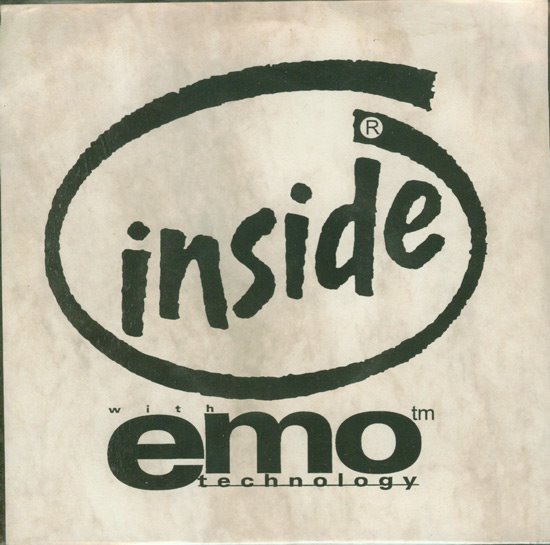
But the next time I encountered the emo-beast was at a One Hundred Words For Snow show at Koo's cafe. Redwood Records put on a veritable emo-fest spanning two-nights, and apparently 100 Words, another band I really liked, fit the bill. Guests could even purchase limited pressings of records with an "Emo Inside" cover that parodied Intel's most likely forgotten identity campaign. That night I took in all the t-shirts and stickers on guitar cases feeling like I'd entered a whole new world. I felt like I was alive and a part of something that was happening now. Luckily, I met some cool folks at work who clued me in to Moss Icon and Rites of Spring before I got too heady over this new 'emo' stuff.
And the more I thought about it (and the more clues I was given), I began to see similarities with artists who were on comps with Born Against. (Let's face it, I never would have bought an Ebullition record if it didn't have that Born Against entry point.) At this point, you could still sort of feel the 'hardcore' element in the music. (Like you could still hear the hardcore through the metal from Integrity.)
I'm not sure if I'm summing it up well, but it wasn't an embarrassing thing to listen to emo records. My punk friends didn't get why a band who's named after a classic Misfits lyric could sound so mellow, but they didn't make fun of me or call me 'emo' because I listened to Texas is the Reason.
But nowadays labeling a band, "Emo," is like a kiss of death. Too many bland and homogenous bands have emerged under the banner of Emo to willing mainstream audience. Same old story. When I mentioned the beats earlier, did you picture Doby Gillis or one of Fred Flintstone's amnesia induced personas? Every event in youth culture is co opted and sold for a profit. I think maybe it just happens faster now.
(Buy Braid Frame and Canvas at Amazon)
(Buy Texas is the Reason Do You Know Who You Areat Amazon)
CACOPHONY AND COFFEE
- OR POP HISTORY
- OF NONEVENTFUL YEARS:
- AN MP3 WEBLOG
Latest posts
- Wake Up it's Time for Work
- Surf Will Tear Us Apart (Again)
- How Much Art Can You Take? (Or There's Something A...
- It Takes Time To Get It Together
- I Keep the One I Love in the Freezer
- My Baby Does the Water Damage
- 1998 Looked Great On Plain White Paper
- How to Fix Oldies Radio
- I Feel This Burning Pain
- Take a Bow
Archives
Links
- 20 Jazz Funk Greats
- Appears.2ya.com
- Banana Nutrament
- Benn Loxo Du Taccu
- Between Thought and Expression
- Bows + Arrows
- Brooklyn Vegan
- Caffeine Headache
- Captain's Crate
- Cocaine Blunts & Hip Hop Tapes
- Cokemachineglow
- Copy, Right?
- Dalston Oxfam Shop
- Diddy Wah
- Domino Rally
- Elbo.ws
- Empires Fall
- Fluxblog
- Gorilla vs. Bear
- Hype Machine
- Indie For Dummies
- Miss Jaime
- Moistworks
- Music For Robots
- Popsheep
- PopText
- Said The Gramophone
- Sit Down Stand Up
- Souled On Music
- Soul Shower
- Soul Sides
- Stereogum
- The Number One Songs In Heaven
- The Rich Girls Are Weeping
- The Tofu Hut
- Underground Cinema
- Underneathica
- Vain, Selfish and Lazy
- We Eat So Many Shrimp
- You Ain't No Picasso
Disclaimers
- Songs posted here are only available for a limited time and are for evaluation purposes only. If you like the music, please show your support and buy the records.
- Feel free to contact Jeff or Patrick if you are a band, label or distributor and think we'd be interested in your music.
- If you are the copyright holder of a song being featured on this blog and want us to take it down, let us know, and it will be removed from the server immediately.
Site Feed